Robotics + Automation
Industrial Monitoring & Operations Platform
UX Research, Discovery, Interaction Design, Prototyping, Product Design

OVERVIEW
The Client is one of the world’s leading industrial technology companies, building advanced robotics, automation systems, electrification solutions, and digital platforms used across factories, plants and infrastructure worldwide.
This project focused on designing a unified digital ecosystem used internally by engineers, sales teams, analysts and support across global operations.
Client
Global Industrial Technology Leader
Project
Modular Customer & Operations Ecosystem
Scope
Multi-role industrial SaaS platform
Timeline
Multi-year transformation program
My role
Lead Product Designer (UX, System Architecture, Research, Lofi → UI, Workshops, Handover)
Users
Engineers, Sales, Business, Support, Operations
INTRODUCTION
Client was undergoing a major internal software revolution.
Their digital tools were fragmented, outdated and built around isolated workflows.
The ambition was radical: replace multiple disconnected systems with one modular platform capable of serving dozens of departments and roles across global industrial operations.
This was not a redesign.
It was building the digital backbone for how Client's teams operate, manage customers, monitor systems and make decisions.
WHO THIS PRODUCT WAS FOR
Based on research from the project's initiative, the platform had to support radically different user groups within one coherent system:
- Field engineers managing installations
- Sales teams configuring industrial offers
- Business analysts reviewing operational data
- Support teams handling service workflows
- Technical operators monitoring devices
- Management reviewing performance and KPIs
One system.
Many realities.
Conflicting needs that had to coexist without breaking usability.


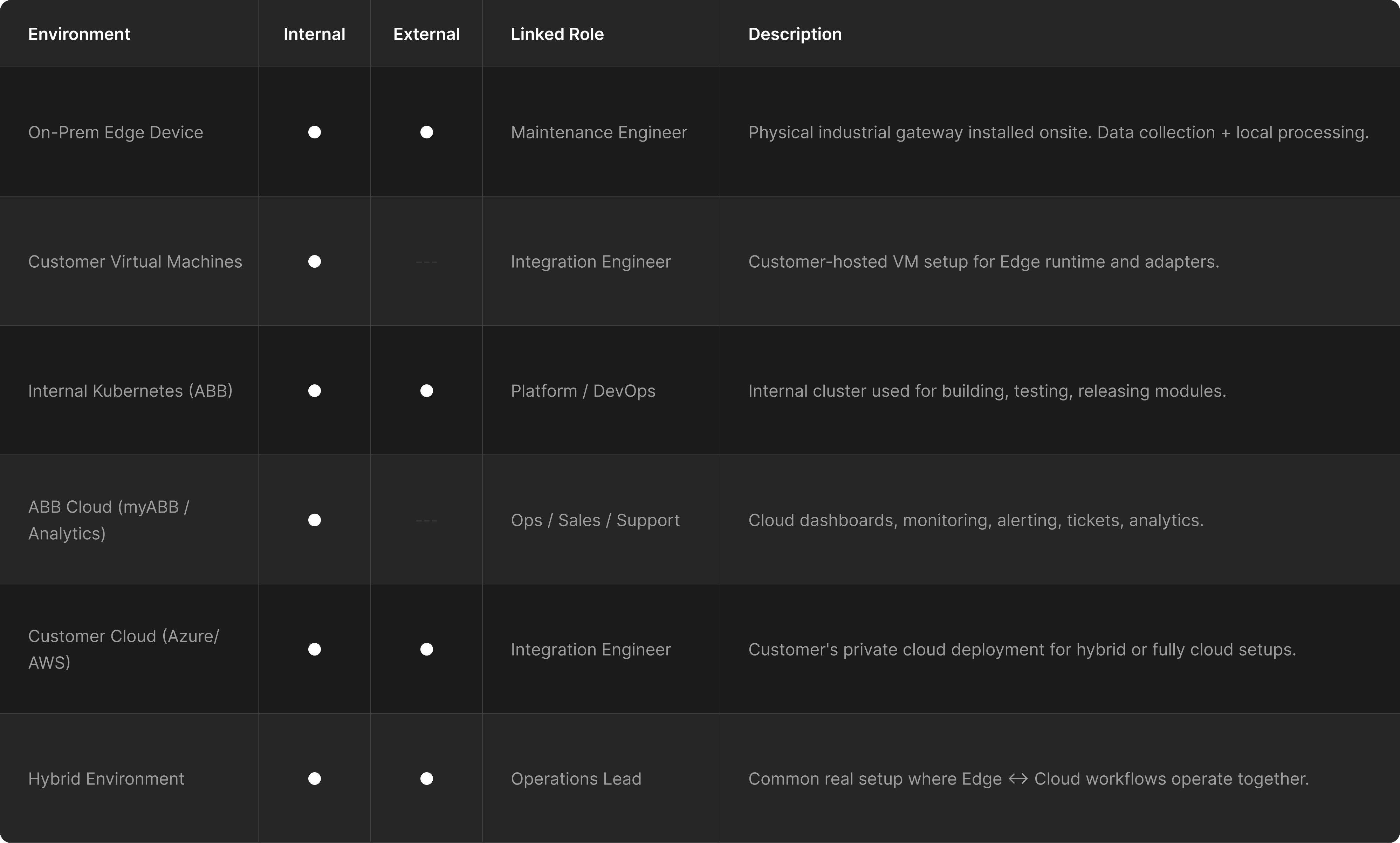
THE ENVIRONMENTS
The system had to work across multiple industrial contexts:
- Factories and production plants
- Power and electrification infrastructure
- Robotics environments
- Heavy industrial facilities
- Distributed on-site service locations
- Remote monitoring centers
Each environment generated different data, workflows and expectations.
THE CHALLENGE
Design one scalable platform flexible enough for daily operational work, yet powerful enough for high-level engineering and business decision-making.
The product needed to support:
- Complex technical data
- Service workflows
- Sales processes
- Device monitoring
- User permissions and roles
- Modular expansion across markets
All within a single coherent UX.
SALES PITCH CONTEXT
To align global stakeholders and accelerate buy-in, I prepared a strategic product presentation showing the vision, modular architecture and interaction model of the ecosystem.
It wasn’t just a design deck.
It was a sales tool used internally to communicate the scale of transformation and secure cross-department adoption.
This presentation later became the foundation for product direction and implementation phases.


RESEARCH & DISCOVERY
The project started with deep stakeholder workshops across multiple departments.
We mapped:
- Existing tools and overlaps
- User responsibilities across roles
- Data flows between systems
- Operational pain points
- Missing visibility and ownership gaps
This research exposed how disconnected processes slowed decision-making and created friction between technical and business teams.

LOFI & SYSTEM ARCHITECTURE
Before visual design, I built structured low-fidelity system flows covering:
- Onboarding logic (steps 1–6)
- User personas and behavioral differences
- Role-based access models
- Industrial environments
- Notifications ecosystem (bento)
- Multi-path workflows
These diagrams acted as the blueprint for the platform’s modular structure and were used to validate complexity early with stakeholders.


INTERACTIVE PROTOTYPING
High-fidelity interactive prototypes were created to simulate real product behavior across roles and scenarios.
This allowed:
- Interaction architecture
- Validating flows before development
- Testing navigation across modules
- Reducing ambiguity for engineering
- Aligning stakeholders visually
- Preventing costly misinterpretations
The prototype became the working model of the product.

DESIGN SYSTEM
To support scale, I designed a modular design system tailored for industrial SaaS.
It unified:
- Multiple product modules
- Complex UI patterns
- Data-heavy dashboards
- Role-specific layouts
- Reusable components across teams
This system allowed Client to expand consistently without rebuilding UX foundations.
OUTCOMES
- Unified fragmented internal tools into one scalable ecosystem
- Enabled cross-role collaboration within a shared platform
- Improved visibility and control across operations
- Reduced product complexity through modular UX structure
- Delivered a system designed for long-term industrial scale


TAKEAWAYS
This project proved that industrial software demands a different level of UX discipline — where architecture, clarity and role separation matter as much as visuals.
Designing for Client meant designing for complexity, responsibility and real-world impact — not just interfaces, but systems that engineers and businesses rely on daily.
Contact
Dribbble — @maciejantkowiak
LinkedIn — maciejantkowiak
Email — antkowiakmaciej@gmail.com
Copyright © MA Studio
All rights reserved.